unixshadow
Hi, I’m Hafeez.
I’ve spent over 30 years running Unix and Linux systems for a living — where downtime simply wasn’t an option.
I started on midrange systems — VAX/VMS and Alpha — back when a server room sounded like a jet engine and a reboot meant a field trip. From there it was Solaris, then Linux (RHEL, AlmaLinux, Debian, Ubuntu), VMware virtualization, NetApp/EMC storage, HPC grid clusters, and eventually cloud infrastructure: LAMP stacks, Oracle RAC, and large patched, hardened Linux fleets.
Along the way I’ve worked across financial services, telecom, retail, manufacturing — Mars (Effem Foods) and PepsiCo — and managed cloud infrastructure — including the better part of a decade running systems where downtime simply wasn’t an option. These days I build and maintain cloud platform environments for customers across the US, UK, Canada, and India.
Where it started
Long before cloud dashboards, the path went something like this: VAX systems and Ingres databases, then Novell NetWare networks, Windows NT desktops, and VAX/VMS clusters — with backup on magnetic tapes, actual tapes in actual boxes, that someone had to actually carry. From there it was Sun: Solaris on SPARC — pizza-box SPARCstations, Sun Fire servers, and later Solaris zones and domains on M4000s — then Linux, virtualization, and cloud. Each step built on the last, and each one taught the same lesson: if the data isn’t there when it’s needed, nothing else you built matters. I still miss the sound of a server room that actually sounded like it was working.
Fun fact: I cut my teeth on Alpha/VAX VMS and Sun-era Solaris — I survived Y2K, the UNIX wars, and servers that literally needed a key to turn on. Back then clustering meant massive physical cables, VMS uptime was the gold standard, and the boxes were built like tanks — pizza-box SPARCstations included, in the era Java was born. Long after the manufacturers moved on, those systems kept running. The instincts they drilled into me still work on everything built since — even on gear most engineers today have only read about.
The path so far
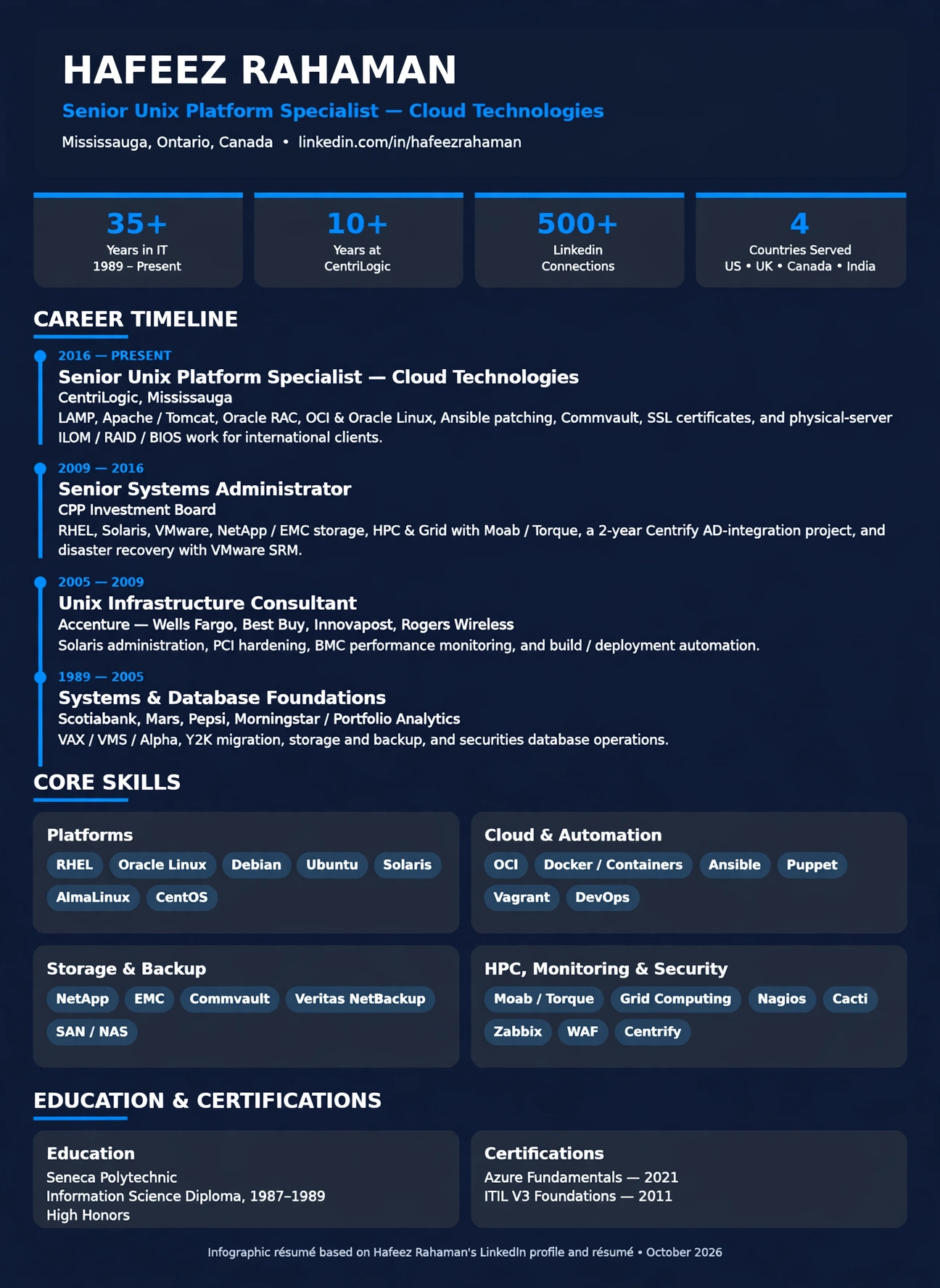
1989 – 2005
Systems & Database Foundations
Scotiabank, Mars, Pepsi, Morningstar / Portfolio Analytics — VAX/VMS and Alpha, Y2K migration, storage and backup.
2005 – 2009
Unix Infrastructure Consultant
Accenture — Wells Fargo, Best Buy, Innovapost, Rogers Wireless — Solaris administration, PCI hardening, performance monitoring.
2009 – 2016
Senior Systems Administrator
CPP Investment Board — RHEL, Solaris, VMware, NetApp/EMC storage, HPC/Grid clusters, Puppet configuration automation, Centrify AD integration, NAS/SAN provisioning, disaster recovery via VMware SRM.
2016 – Present
Senior Unix Platform Specialist, Cloud Technologies
CentriLogic, Mississauga — LAMP, Apache/Tomcat, Oracle RAC, Ansible patching and playbooks, OCI/Oracle Linux, and cloud platform environments for customers in the US, UK, Canada, and India.
What I work with
Solaris
SPARC
Sun Fire
RHEL
AlmaLinux
Debian
Ubuntu
VMware
NetApp
EMC
HPC / Grid
LAMP
Apache
Tomcat
Oracle RAC
Ansible
Puppet
Commvault
Docker
Vagrant
Nagios
Zabbix
Cacti
LogicMonitor
SolarWinds
LDAP
NFS
CIFS
Samba
SAN
NAS
LVM
DTrace
Centrify
DevOps
Automation first
If a task is worth doing twice, it’s worth automating. I write Ansible playbooks for operating system configuration and patching (via Ansible, yum/dnf), and used Puppet Enterprise to automate post-OS builds — user accounts and permissions, install directories, and application requirements — so a new server lands consistent, not hand-tuned. Underneath that is the usual sysadmin toolkit: shell scripting in bash and ksh, sed and awk, cron jobs, rsync and tar for backups, and SSH-keyed operations between servers. Large-scale automation is how a fleet stays patched and hardened without turning every change into a weekend.
Storage & protocols
I’ve provisioned NAS and SAN on NetApp and EMC — LUNs, replicated storage volumes, and block devices — and served it to users over Samba, CIFS, and NFS, alongside LDAP for authentication and Centrify for Active Directory integration to Unix. Backup and recovery sit next to that, not after it: Commvault configuration and migration, Veritas NetBackup, and NetApp snapshots for fast recovery. It’s the unglamorous layer everything else depends on — get the filesystem, the share, and the restore right, and the applications mostly take care of themselves.
Monitoring: if it isn’t watched, it isn’t managed
A system nobody is watching is just an outage waiting for a user to report it. I’ve built monitoring with Nagios, Zabbix, Cacti, LogicMonitor, and SolarWinds, plus NetIQ AppManager and custom scripts written to watch the specific servers and applications that actually mattered — and at Rogers, integrated BMC performance management into a wireless network so the operations teams could see trouble coming. The point was never a prettier dashboard; it was knowing about a problem before the phone rang, and having the performance data to prove what fixed it.
Why unixshadow.com?
After three decades of provisioning servers, fighting 3 AM outages, evaluating hosting providers with real money on the line, and patching everything from kernel vulnerabilities to OpenSSL heartbleeds — I’ve developed strong opinions about what makes good infrastructure, and what doesn’t.
This site is where I share those opinions: honest VPS and hosting reviews, practical Linux guides, and free sysadmin tools I actually use myself. No marketing fluff, no paid placements dressed up as reviews. When I recommend something here, it’s because I’d run it in production myself.
Credentials
Seneca Polytechnic — Information Science diploma, High Honors · Azure Fundamentals · ITIL V3 Foundations · Government of Canada Secret (Level II) security clearance.
You can find my full professional background on LinkedIn.
The full picture
Career timeline, core skills, education and certifications — at a glance:
Disclosure
unixshadow.com participates in affiliate programs. If you buy hosting through links on this site, I may earn a commission at no extra cost to you — it keeps the servers (and the tools) running.